
Lani Kramer: Marshall Islander
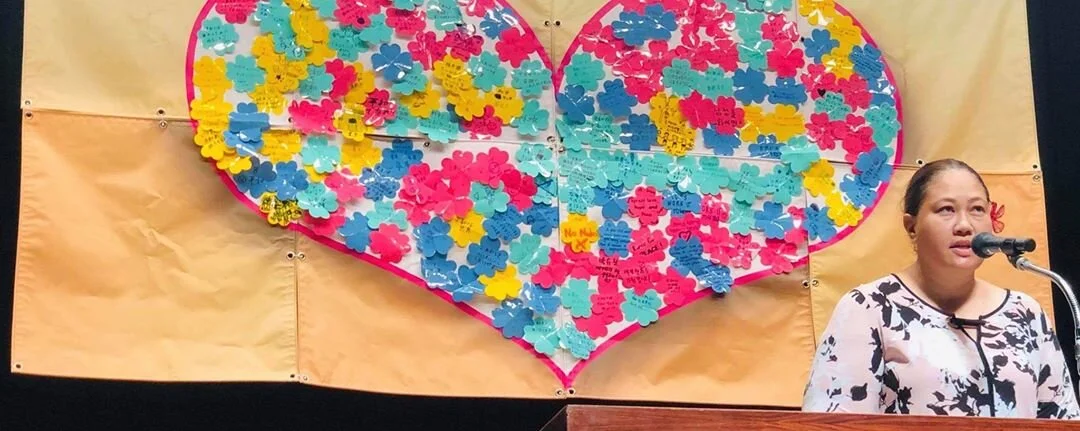
The following is an excerpt of a presentation by former REACH-MI President Lani Kramer at 2019 World Conference Against A & H Bombs. Read the full presentation here.
I am the President for REACH-MI, which stands for Radiation Exposure Awareness Crusaders for Humanity- Marshall Islands.
Our mission is to provide information, spread awareness, and explore ways to address unresolved nuclear issues to improve community conditions and people’s lives in the Marshall Islands.
We also believe, that we need to educate the world on our nuclear legacy so that it doesn’t happen again to other innocent people.
My story is about my grandmother and her people. My grandmother was born in 1938 on Bikini Atoll. Bikini Atoll was the site of the US nuclear weapons testing from 1946 to 1958.
In February of 1946, the US military asked the people of Bikini if they could use their land “for the good of mankind”. The people of Bikini didn’t know what that meant, but they were scared of these powerful people. All that Juda, the leader of the islanders, could say was, “everything is in God’s hands”.
So on March 7, 1946, the 167 islanders, including my grandmother, took all their belongings and their houses and canoes, and boarded the big navy ship to settle on Rongerik, an island 125 miles east of Bikini. You have to understand that in our culture, land is everything, it is our identity, it is our ancestral right that is passed down to our children and grandchildren. And when our precious land is taken away, we have nothing, we are lost.
The Bikinians arrived on Rongerik, which was much smaller than Bikini and within 2 months the people were starving. Not only was there not enough food on the land, the fish in the lagoon on Rongerik were toxic so they couldn’t eat them.
In July of 1946, the first 2 bombs were dropped on Bikini, Able and Baker, each of them the size of the bomb dropped on Nagasaki. A year later, in July 1947, a medical officer went to check on the islanders and was shocked to find them starving.
6 months later, on January 1948, an anthropologist named Dr. Leonard Mason, was asked to go check on the Bikinians living on Rongerik. When he saw the state of the people, he immediately requested for food and medical assistance. The US govt then decided to move the people once again. In March of 1948, the U.S. Government took the islanders to Kwajalein Atoll where they set them up in tents right alongside the airport runway where planes were landing and taking off. For six months they slept there until they were placed on Kili Island. A small island, only about a mile long and wide, with no lagoon. The U.S. Government forced the people to clear the land again and build their own houses.
For over 70 years, the people of Bikini have been living on this small island. When the Bikinians used to live on Bikini, we lived off the land and ocean and it was enough to feed our people. We were legendary throughout the Marshall Islands as navigators, canoe builders, and fishermen. Now, being on an island with no lagoon, we have lost our traditional skills.
On March 1st, 1954, on Bikini Atoll, the Bravo test, was the largest hydrogen bomb ever exploded by the United States. It was 1000 times more powerful than the bomb dropped on Hiroshima. Bikini Atoll had 26 islands, but after the Bravo test, 3 of our islands were vaporized and sent miles up in the air along with all kinds of ocean debris, reef, sand, coral.
4 hours after the blast, white powder came down on the people of Rongelap, the children played in it, the island was covered in 2 inches of fallout. Soon, the people became sick, their hair fell out, their skin was burned, they were itchy, nauseas, throwing up.
The people of Rongelap didn’t receive any help for 2 days until the US Navy finally took them to Kwajalein for medical attention.
It is strange that the US Navy moved the people out of Rongelap for the series of tests in 1946 under Operation Crossroads. But, they didn’t move them out of Rongelap before the big Bravo test and other series of tests under Operation Castle. In fact, even though the Brookhaven Reports stated that Rongelap was the most radioactive place in the world, they let the islanders move back to Rongelap in 1957.
To this day, the people have not returned to Bikini as the land is still not safe to live on, the food not safe to eat.
The United States promised us they would take care of us and eventually we would be allowed to return home. The original 167 people that left Bikini are dying off and have realized they will never return home.
My grandmother passed away on January 3rd, 2018. She left her beautiful Bikini home when she was 8, singing and waving when she was on the big US navy ship, and died at the age of 79 on Majuro, the capital of the Marshall Islands. Her dream of going back to Bikini was only a dream.